İrem Kalender
Why No One Moves: The Hidden Logic of Nash Equilibrium
In this blog we are trying to explore the Nash equilibrium and it's implications.
ECONOMICS
4/21/20264 min read
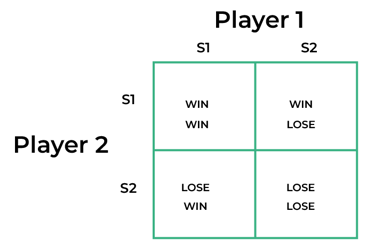
Named after the famously known mathematician John Nash, Nash equilibrium is a profile of strategies (s₁ ,…, sₙ) such that each player’s strategy is a best response to the strategies of the other players; that is, no player has an incentive to deviate unilaterally.
Nash equilibrium doesn’t only belong to economics or game theory—it’s actually one of those ideas that quietly sits underneath a lot of systems we see in real life. From psychology to political science, from biology to computer science, it shows up anywhere decisions are interconnected. The core idea is simple but powerful: when everyone is making choices while considering what others are doing, the system often settles into a kind of “stable point” where nobody wants to change their decision alone.
What Nash equilibrium really means
At its core, Nash equilibrium is about strategic stability. It describes a situation where each individual’s decision is optimal given what everyone else is doing. And the key detail is this: people are not trying to be globally optimal, they are just responding rationally to their environment.
In real life terms, it’s like being in a group where everyone adjusts their behavior based on others, and eventually you reach a point where any single person changing their behavior alone would make things worse for them. So nobody moves. Not because everything is perfect, but because unilateral change doesn’t help.
This is why Nash equilibrium is less about “ideal outcomes” and more about “stable outcomes.”
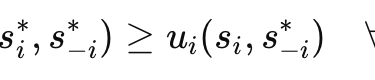
Mathematically, in a game with nn players, each player ii chooses a strategy sisi, and has a payoff function uiui. A strategy profile (s1,...,sn)(s1,...,sn) is a Nash equilibrium if:
But instead of reading it as a strict mathematical condition, it’s more useful to interpret it in words.
Each player compares two things: what they get if they stick to their current strategy, and what they would get if they change it while everyone else stays the same. If changing doesn’t improve their payoff, they stay where they are.
So a Nash equilibrium is basically a situation where:
everyone is already doing the best they can, given what everyone else is doing.
In economics, Nash equilibrium is one of the most important tools because it helps explain behavior in systems where individuals or firms constantly react to each other.
In competitive markets, firms don’t make decisions in isolation. If one company lowers prices, others respond. If one innovates, others adapt. Over time, these reactions create a stable structure where no firm can improve its outcome just by changing its strategy alone. This is why many market outcomes look “sticky” or predictable even when firms are actively trying to outperform each other.
Nash equilibrium helps economists understand why certain pricing patterns, market shares, or competitive behaviors persist even when everyone is trying to maximize profit.
Labor markets and unemployment
One of the most interesting applications of Nash equilibrium appears in labor economics, especially in Christopher Pissarides’ Equilibrium Unemployment Theory.
What his framework shows is that unemployment can exist even when everyone is behaving rationally. Firms are deciding whether hiring is worth the cost, and workers are deciding whether to accept offers or wait for better ones. Both sides are optimizing, but their decisions interact.
The result is a stable equilibrium where some level of unemployment persists—not because of inefficiency in a simple sense, but because it is the outcome of rational strategic behavior. No single worker or firm can change the system alone in a way that eliminates unemployment entirely.
Public goods and shared resources
Elinor Ostrom’s Governing the Commons starts from the idea of equilibrium and builds on it to understand how people manage shared resources like forests, fisheries, or water systems.
The basic problem is that when a resource is shared, each individual has an incentive to use as much as possible. If you don’t use it, someone else will. But if everyone thinks like that, the resource gets overused and eventually damaged.
This leads to a Nash equilibrium where everyone overuses the resource, even though everyone would be better off cooperating. The important insight is that the equilibrium is stable—not because it is good, but because no one can improve their outcome by changing behavior alone.
Competition and spatial behavior
Harold Hotelling’s Stability in Competition provides a very intuitive example of Nash equilibrium in action. His model explains why competitors often cluster together instead of spreading out.
Imagine two ice cream sellers on a beach. Each wants to attract as many customers as possible. If one moves slightly away from the center, they risk losing customers to the other seller. Eventually, both end up in the middle of the beach.
This outcome is a Nash equilibrium because neither seller benefits from moving independently. Even though it might seem inefficient for customers, it is stable from the perspective of the firms.
Incentives and system design
Laffont and Martimort, in The Theory of Incentives, extend Nash equilibrium into the design of economic systems. Their focus is not just on predicting behavior, but on shaping it.
They show that institutions—like tax systems, contracts, or auctions—need to be designed while accounting for how people will behave strategically. If you know people respond according to equilibrium logic, then you can design incentives so that the resulting equilibrium leads to better outcomes.
This is where game theory becomes very practical: it becomes a tool for building systems, not just analyzing them.
Although Nash equilibrium is heavily used in economics, its reach is much wider. In psychology, it helps model how people behave in social settings where expectations matter. In biology, it appears in evolutionary stable strategies, where species adapt in ways that resemble equilibrium behavior. In political science, it explains voting behavior, coalition formation, and negotiation outcomes.
Even in computer science and AI systems, Nash equilibrium appears in network routing, algorithm design, and multi-agent systems where different agents interact and adapt to each other.
The common thread is always the same: multiple decision-makers, interdependent outcomes, and strategic adaptation.
Nash equilibrium is about stability. It describes situations where everyone is doing the best they can given the circumstances created by others. This is why it is so powerful: it explains why systems settle, why coordination is difficult, and why rational behavior does not always lead to ideal outcomes.
Once you start seeing it, it becomes almost intuitive. Markets, friendships, negotiations, even everyday decisions often follow the same structure. Everyone is reacting to everyone else, and eventually the system finds a point where no one has a reason to move alone.
That is the essence of Nash equilibrium: not the best world, but the one that no one can individually escape.
Some resources I would recommend:
Investopedia: https://www.investopedia.com/terms/n/nash-equilibrium.asp
Khan Academy: https://www.youtube.com/watch?v=UkXI-zPcDIM
FT: https://www.youtube.com/watch?v=q7JEsaC4ADs
Works Cited
Fudenberg, Drew, and Jean Tirole. Game Theory. MIT Press, 1991.
Hotelling, Harold. “Stability in Competition.” The Economic Journal, vol. 39, no. 153, 1929, pp. 41–57.
Laffont, Jean-Jacques, and David Martimort. The Theory of Incentives: The Principal-Agent Model. Princeton University Press, 2002.
Ostrom, Elinor. Governing the Commons: The Evolution of Institutions for Collective Action. Cambridge University Press, 1990.
Pissarides, Christopher A. Equilibrium Unemployment Theory. MIT Press, 2000.

Contact
Feel free to reach out for collaborations or questions.
irem.kalender@ug.bilkent.edu.tr
© 2026. All rights reserved.
www.linkedin.com/in/iremkalender7